
Moving heads, wash, effects and haze, delivered, rigged and focused by our crew, then set to run sound reactive or run live by a lighting engineer. Dance floor lighting for weddings, quinceañeras, school dances, corporate parties and club nights across Dallas-Fort Worth. Every rig is designed around your room and the floor it has to cover.
“DJ lighting” usually gets pictured as a couple of fixtures on sticks either side of a booth, flashing to the beat. That is the version most people have seen, and it is also the version that makes a room look smaller than it is. Real dance floor lighting is a rig aimed at a specific piece of floor, in a specific room, with the fixtures chosen for the ceiling height and the crowd size in front of them.
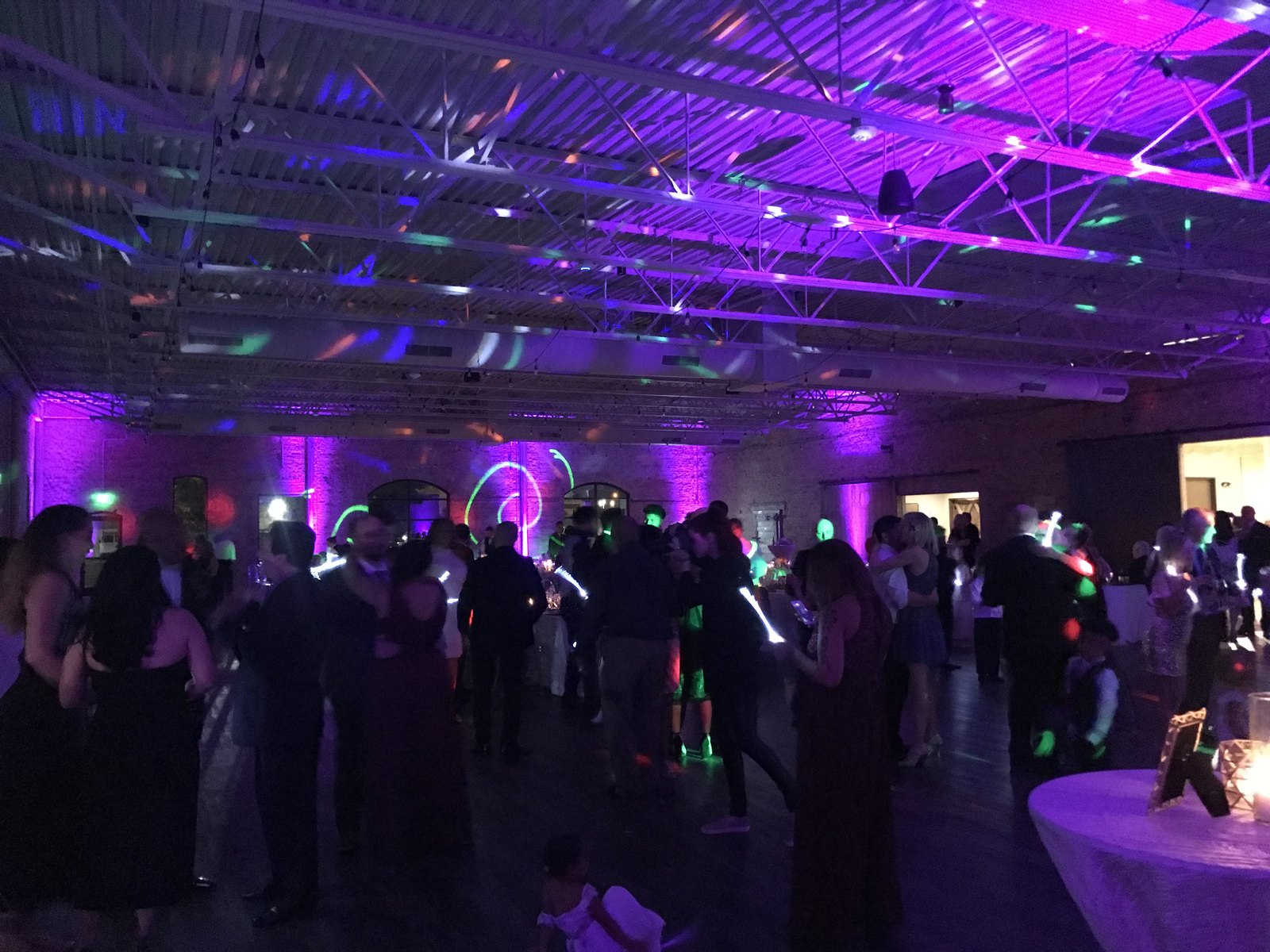
The difference is easy to see and hard to describe in a quote line. A designed rig has layers: something covering the floor in color, something cutting through the air above it, something adding texture on the walls, and haze to make any of it visible. Take one layer away and the whole thing flattens out. Add all four and a hotel ballroom stops looking like a hotel ballroom.
How the rig gets run depends on what is in it. DJ lighting is set up, aimed and put into sound reactive mode as standard, so the fixtures follow the music on their own all night. We deliver, place, aim, set the mode, and come back after the gig to strike. If you would rather have the looks run by hand, ask for a lighting engineer and we will put one on the job to run them live. More involved lighting, moving heads and anything cued to a show, runs from a lighting console with a technician, because that is what running that kind of rig takes.
We build the rig around your floor either way. It is part of the wider event lighting we do, and it works whether we are your DJ or your DJ is somebody else entirely.
A moving head, the family of fixtures also called intelligent lighting, is a lamp mounted in a motorized yoke that pans, tilts, changes color, changes beam shape and dims on cue. A static fixture points at one thing all night. A moving head points at whatever the song needs at that moment, and then somewhere else eight bars later.
Practically, that is what buys the variety. The same four fixtures can sit still and wash the floor in warm amber during dinner, then open into fast sweeping beams over the crowd an hour later, then lock into a tight cone on a couple for a spotlight dance. You are renting fixtures that produce all six looks rather than six separate looks.
They come in broad families: wash heads with soft wide output for covering people and floor, and spot or beam heads with a tight hard edge for cutting through air and projecting patterns. Most rooms want some of each. Moving heads are where a lighting console and a technician come in. They are patched, programmed and run live as part of the show.
Not every event needs all of these, and part of our job is telling you which ones your room genuinely benefits from. This is the vocabulary, and knowing it makes every lighting conversation you have, with us or anyone else, a shorter one.
Soft-edged, wide-output moving fixtures that put color onto the floor and the people on it. This is the layer that makes a dance floor feel like a defined place rather than a patch of carpet, and because the heads move, the same fixtures cover the cake table earlier in the night and the dance floor later.
Hard-edged, tight-output heads that throw a visible shaft of light instead of a soft pool. These are what produce the sweeping, crossing beams over a crowd, the aerial fans, and the sharp pattern work on floors and walls. They are also what most people are picturing when they say they want the room to look like a concert.
Fixed LED fixtures around the perimeter and along the walls, holding a color that the moving lights work against. Uplighting is doing a different job from the dance floor rig. It dresses the room, and the two are designed together, because a room the venue keeps lit brightly is what dance floor lighting has to work against.
Derby, wash-bar and multi-beam effect fixtures that fill air and floor with fast-moving color across a wide angle. They do the one thing moving heads leave to them: cover everything at once. Used well they sit underneath the rest of the rig and give it energy; used alone they are what makes a room read as under-lit rather than designed. These are the fixtures that run sound reactive by default, following the music on their own. At a recent wedding the uplights did the same trick: after the bride's surprise reveal in alternating pinks, we opened the floor and the whole perimeter followed the beat of the music for the rest of the party.
High-output white fixtures used in seconds, not minutes, a drop, a chorus, a countdown, a grand exit. Strobes point at the floor and blinders point back at the crowd. Both are entirely about restraint: they land because they are rare, and we always check photosensitivity concerns and venue rules before programming them in.
A beam is invisible until there is something in the air for it to reflect off. A light, even haze is what turns moving heads from bright dots into visible shafts of light. It is a small addition to any rig and the one that makes the beams you are paying for visible. Venue clearance and alarm coordination are ours to handle.
Staffed laser systems with safety planning and audience-scanning discipline, for events big enough that the lighting rig alone will not carry the moment. A technician runs them live all night. There is a dedicated page on how we run them.
Fixtures need to be up in the air to do anything useful, and how they get there changes with every venue. Ground-supported truss, uprights and totem stands cover most rooms while leaving the building untouched, which is what churches, historic venues and most hotels require. Cable is routed and taped, and every guest path stays clear.
Most people arrive knowing what they want the room to feel like and not which fixtures produce it. That is the normal starting point. Send a photo of the room, a link to the venue, or a picture off Instagram of a dance floor you liked. That is more useful than a fixture list, and we will work backwards to the rig from there. Start at our quote form.
Two events on the same date with the same guest count can need completely different lighting. These are the six things we look at before proposing anything, and they are the reason every rig is quoted for its room.
A rig is designed to cover a specific piece of floor from specific angles. A 20×20 floor in the middle of a 300-person ballroom needs a completely different plot from a 40-foot-wide floor along one wall, even though the guest count is identical. Tell us the floor size and where it sits and half the design is already decided.
High ceilings let fixtures get up where beams can spread and cross overhead; low ceilings mean shorter throws, flatter angles and different fixture choices to avoid blinding people at eye level. A room with a nine-foot ceiling is its own design, separate from a room with a twenty-foot one. It is a different problem.
Some venues offer truss, catwalks or existing rigging points. Most have nowhere to hang from, in which case everything is ground-supported and needs floor space and clean sightlines. Historic and religious venues frequently prohibit attaching anything to the structure, which we plan around rather than argue with.
A real rig draws real power, and the circuit behind the DJ booth is often already carrying the audio. We confirm available circuits with the venue in advance and bring distribution and cable to reach them. Finding a power limit weeks out is a routine conversation, and finding it at load-in on a Saturday is a real problem.
A lighting design lands when the ballroom comes down from full brightness. Part of the plan is agreeing in advance who dims what and when, venues vary from full dimming control to a single switch to lights that stay as they are. Where the house stays bright, we design for a bright house.
The same room needs warm, still, low-level light during dinner and something entirely different two hours later. A designed rig covers both from the same fixtures. Where you want that transition called by hand, running it is a big part of what a lighting engineer or a console technician is there for. It also keeps the club lighting where it belongs, after dinner.
The lighting has to do two opposite jobs in one night: warm, still and photograph-friendly through dinner and toasts, then a genuine dance floor after. Moving heads handle both from the same positions. Paired with uplighting and a monogram, it is usually the change guests notice, and the one that shows up in every photo of the night.
Big guest counts, a long formal opening and then hours of serious dancing. These events lean hard on color and on the moment of transition from the presentation to the party. A rig with real moving heads and a proper haze layer is what makes the surprise entrance and the choreographed number land the way they were planned.
Usually a gym or a cafeteria, big flat rooms with overhead lighting that is either fully on or fully off. That is where a designed rig makes the largest difference, because the baseline is so plain. We also work to school rules on strobes, fog and content, and coordinate with staff on load-in.
Company holiday parties, sales celebrations, employee appreciation nights and brand activations. The rig can carry brand colors, sync with a program, and hold a general-session look before the room turns over to a party. Add a projected logo and the room reads as designed rather than rented.
Here the lighting is the show, and it is expected to be run live to the music rather than programmed and left. Heavy on beam fixtures, haze, strobe and, where it fits, lasers. This is the hardest version of a dance floor rig to run, and it goes out on a lighting console with a technician on it all night.
A band needs the stage lit before it needs the room lit, front wash so faces read, then color and beam work behind and above for the show. Moving heads cover both from one rig. Where a solo needs picking out of the band, that is a follow spot job and we run those too.
We propose a rig for your floor, your ceiling and your night, and the fixture count comes out of that design. If a layer adds little to your room, we say so and leave it off the quote.
We bring it, build it, aim it and take it away. Delivery, setup, strike and collection are all ours, so your Monday stays clear.
Sound reactive fixtures are aimed and set to the mode on site, so they follow the music from the first song. Console rigs are patched and programmed to your room before doors, with looks built for each part of the night.
DJ lighting runs sound reactive on its own, so we deliver it, set it up and come back after the gig to strike. Ask for a lighting engineer and one of our crew stands behind the looks and runs them live instead. Moving heads and show-cued rigs run from a lighting console with a technician.
Circuits confirmed with the venue in advance, distribution brought with us, and every run routed and taped, with every guest path clear.
Load-in windows, rigging rules, fog and haze clearance and alarm coordination handled before the day. We have worked in most DFW venues already.
Certificates of insurance issued to your venue on request. We have been fully insured and working in this market since 2001.
Where we are also your DJ or your audio, the rig shares a load-in, a crew and one cue sheet, so the lighting hits with the music rather than a second behind it.
Date, venue, guest count and roughly where the dance floor sits. A photo of the room or a link to the venue tells us more than a fixture list would.
Fixture types, positions, rigging method and power, worked out for your floor and ceiling. You get a straightforward quote back within 24 hours.
On a sound reactive rig we agree the placement and the mode. Where a lighting engineer or a console is on the job, we take your run sheet and build looks for each part of the night, arrival, dinner, the formal dances, the transition and the peak, and agree who is calling the show.
We arrive inside your venue’s window, build the positions, run and secure power, aim every fixture at the actual floor and check the room dark before doors.
Sound reactive fixtures run themselves and we come back after the gig to strike. Where you have a lighting engineer or a console technician, they run the rig live all night and adapt when the timeline moves. Either way everything comes out cleanly and quietly at the end.
We quote each event on its own, because every room earns its own number. What moves it is the room and the ask: the size of the floor, how high fixtures need to get and what they hang from, how many layers the room genuinely needs, how long the crew is on site, and whether we are already there for your sound or DJ. Send the date, the venue and a picture of a dance floor you liked and you will have a real quote back with the rig described in it.
The dance floor is one part of a room. These are the things most often booked alongside it, and each of them makes the rig itself work better.
Wireless battery uplights around the perimeter give the walls a color, which is what lets the house lights come down while the room stays lit in your color. Uplighting and dance floor lighting are the same design decision made in two places, and planning them together gives you a better result than adding one to the other later.
Moving heads run a programmed cue; a follow spot has a person on it who adapts when a bride stops halfway down an aisle. A follow spot with a trained operator tracks a person in real time, grand entrances, first dances, award presentations. The two do genuinely different jobs and the best rooms have both.
Haze makes beams visible; low-lying fog puts a first dance on a cloud of white that sits at ankle height and stays there. Different machines, different effects, both needing venue clearance and alarm coordination, both handled by us.
Initials, a date, a company logo or a sponsor mark projected onto the dance floor, a wall or a drape. It is the still image the moving lights orbit around, and it is the detail most likely to end up as the photo people keep.
Lighting run by the same company running the music means the rig responds to what is happening in the set instead of to a clock. If you already have a DJ you love, that is fine too. We light plenty of floors for other people’s DJs and coordinate directly with them.
Most lighting cues are audio cues, an introduction, a song, an announcement. One vendor means both land together. Every microphone we send out runs our AI-powered De-Feedback system, so a toast or an introduction comes through clean. There is more in our De-Feedback explainer.
Based in the mid-cities, we cover roughly a forty-mile radius taking in Dallas, Fort Worth and everything between and around them. We have worked in most of the venues you are considering, which shortens the conversation about rigging positions, power and load-in windows considerably.
If your venue is further out, ask anyway. We will tell you honestly whether it works rather than quoting you a trip we should not make.
Send the date, the venue and a picture of a dance floor you liked. Tell us about your event and you’ll hear back from us today, with a straightforward quote within 24 hours.